


Venezuela: National Security = Personal Insecurity
Venezuela: National Security = Personal Insecurity
El Libertario, Venezuela12 oktober 2008 – 00:46
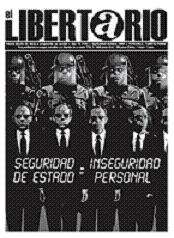
* This Editorial from El Libertario (#54, September-October 2008, Venezuela) examines – from the current Venezuelan perspective – how authoritarian power builds its own security upon the destruction of collective security.
Civil insecurity is a problem that has certainly been inherited by the so-called Bolivarian government, the product of, among other things, an immense social debt with large sectors of the population, getting worse to the point of being considered the mayor problem experienced everyday by the people of Venezuela.
The reasons for the government’s incompetence are many: the traditional emphasis on repressive policies, the lack of a structural transformation that significantly ameliorates poverty, police corruption, impunity for the crimes committed by the powerful - whether the traditional oligarchy or the growing boli-bourgeoisie – and a criminal penal system to punish the poor. The ambiguous institutional response has its origin in the state’s use of personal insecurity as a tool for social control. The permanent threat of violation of personal integrity, certain or improbable, has destroyed the invisible links that form the social communitarian fabric and have relegated individuals to their private spheres, abandoning the public space, that marketplace where the transformation of reality implies agreement and solidarity with people different than us.
The perpetual coercion created by the sensation of insecurity changes comradeship to mistrust, separating the city’s inhabitants into their private reserves, making easier their control and manipulation. Therefore the relationship between people and politics, formerly exercised face to face in public spaces, becomes a spectacle, in our case via television images and a simulated participation, harmless and empty of content. This kind of politics based on media spectacle and summit agreements behind closed doors has been advanced by both sides of the struggle in our country. This polarization, earnestly built and maintained, has allowed the few to continue deciding for and oppressing the majority, locked up in their homes and afraid to come out to demand, defend and conquer their rights. As long as the police and criminals of all sorts – among them the professional politicians – continue ruling the streets, it will be much harder for regular people to combat misery and inequality. The resulting self-imposed curfew validates the notion that in order to control the minds it is also necessary to control the bodies. Because all this the “managers” of chavism and of the opposition can afford to shed their pretenses – their false interest in the people’s plight – and show their true thirst for power, dedicating a whole year exclusively to their electoral campaigns.
In contrast between the government’s tolerance for a certain level of violence and its use as a tool to hinder free association, the Venezuelan government has increased its policies of concentration of power and preservation of its own security. The growing purchase of weapons, the legalization of para-state militias, the creation of military regions and operational theaters are initiatives to maintain and secure the internal order against any popular discontent. In the same vein we have the delegation of police activities to communal councils and social networks, surveillance and snitch activities we must strongly reject and condemn. Thus the Bolivarian government reinforces the global trend: the more state security the less personal security.
A first step to reverse the problem of insecurity is to understand it in all its complexity in order to act consequently. As all rigorous investigations on the subject demonstrate, the principal culture medium is one of the most unfair distributions of wealth in the continent. Because of this our country has one of the largest levels of violence in the region, a situation that spreads like cancer to all areas of life and that, far from diminishing, as a real and integral transformation of society would entail, gets worse day by day. But it is never too late to start. Defeating fear and mistrust, we must come out in public to the streets and plazas of our cities, to see in others our own suffering. Distanced from labels and divisions imposed from above, we will start to act together again, by means of the organizations we will freely create out of our demands and against all those institutions that limit our self-realization and our just, whole and dignified lives in common.
[El Libertario #54 contains several works (in Spanish) where we describe and analyze this theme for the Venezuelan case. See www.nodo50.org/ellibertario where you’ll find the complete issue in pdf format]
Nieuwslijnmeer

- Indymedia.be is niet meer
- Foto Actie holebi's - Mechelen, 27 februari
- Lawaaidemo aan De Refuge te Brugge
- Recht op Gezondheid voor Mensen in Armoede
- Carrefour: ‘Vechten voor onze job en geen dop!’
- Afscheid van Indymedia.be in de Vooruit in Gent en lancering nieuw medium: het wordt.. DeWereldMorgen.be
- Reeks kraakpanden in Ledeberg met groot machtsvertoon ontruimd
- Forum 2020 en de mobiliteitsknoop
- Vlaamse regering kan niet om voorstel Forum 2020 heen (fietsen)
- Fotoreportage Ster - Studenten tegen racisme


Vanwaar komt het geweld? Is
Valentine, 12/10/2008 – 10:28
Vanwaar komt het geweld? Is dit gericht tegen de revolutie van het volk in Venezuela en Bolivia?
Mossadegh is ook op die manier afgezet door de CIA in 1953. Dit is toegegeven in de jaren 80 door de president van de VS die officieel excuses heeft aangeboden voor het opruien van de mensen in IRAN in 1953 en omver werpen van de democratisch gekozen president om de Sjah terug aan de macht te krijgen .....
"Zeker honderd actievoerders verzamelden voor de VS-ambassade verleden vrijdag. De onmiddellijke aanleiding was het protest tegen de centrale rol die de VS speelt in de gewelddadige poging voor de omverwerping van de linkse regering in Bolivia. Ook de recente onthulling van een nieuwe militaire samenzwering tegen de Venezolaanse president Hugo Chavez werd op de korrel genomen. Meer algemeen was het ook een steunactie voor de revoluties in beide landen."
http://www.vonk.org/content/view/2240/35/